Introduction
OSB (Oriented Strand Board) is one of the most widely used engineered wood panels in modern construction. Yet many buyers are confused about the difference between OSB2 and OSB3 — and end up choosing the wrong grade for their application. This mistake can lead to swelling, delamination, and structural failure.
In this guide, Linyi Solland International Trade Co., Ltd. breaks down the real differences between OSB2 and OSB3 so you can choose with confidence.
What Is OSB?
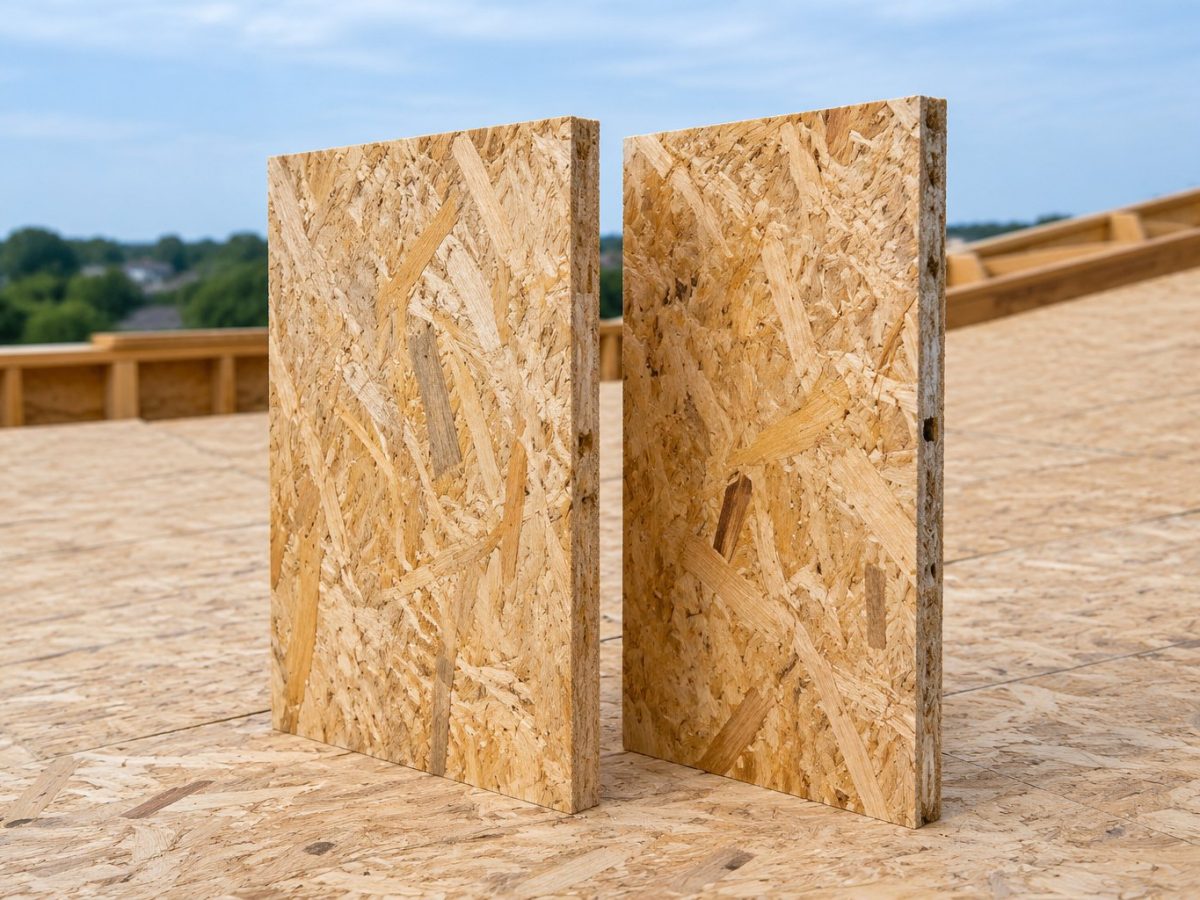
OSB (Oriented Strand Board) is an engineered wood panel made by compressing wood strands with waterproof adhesives. The strands are arranged in cross-oriented layers (typically 3–5 layers), with the surface layers aligned parallel to the panel length and inner layers perpendicular.
Composition:
- Wood strands (aspen, poplar, pine, or mixed hardwood): 95%–97%
- Adhesive (MDI, PF, or MUF): 3%–5%
- Wax: 1%–2% (for moisture resistance)
The result is a strong, rigid, dimensionally stable panel at a competitive price.
OSB Classifications Explained
OSB is classified by EN 300 (European Standard) into four grades:
| Grade | Environment | Description |
|---|---|---|
| OSB/0 | — | General purpose, no formal standard |
| OSB/1 | Dry interior | General purpose boards for dry conditions |
| OSB/2 | Dry structural | Load-bearing boards for dry conditions |
| OSB/3 | Humid structural | Load-bearing boards for humid conditions |
| OSB/4 | Heavy-duty humid | Heavy-duty load-bearing for humid conditions |
In the North American market, OSB is classified by APA (The Engineered Wood Association) using performance-rated sheathing grades. The most common:
- APA Rated Sheathing — equivalent to OSB/2 (dry)
- APA Rated Sheathing — Exposure 1 — equivalent to OSB/3 (humid)
- APA Rated Sturd-I-Floor — equivalent to OSB/3 with enhanced properties
This article focuses on OSB2 vs OSB3 as they are the most commonly compared.
OSB2 vs OSB3: Quick Comparison
| Feature | OSB2 | OSB3 |
|---|---|---|
| Standard | EN 300 | EN 300 |
| Environment | Dry interior | Humid interior |
| Moisture resistance | Low | Medium-High |
| Adhesive type | MUF (Melamine-Urea-Formaldehyde) | MUF or PF (Phenolic) |
| Load-bearing | Yes | Yes |
| Bending strength | 22 N/mm² (min) | 22 N/mm² (min) |
| Modulus of elasticity | 3,500 N/mm² (min) | 3,500 N/mm² (min) |
| Swelling (24h) | ≤ 20% | ≤ 15% |
| Internal bond | 0.34 N/mm² | 0.34 N/mm² |
| Formaldehyde | E1 (≤ 0.124 mg/m³) | E1 (≤ 0.124 mg/m³) |
| Price (USD/m³) | $220–$320 | $260–$380 |
| Color | Light golden | Slightly darker yellow-brown |
| Best for | Indoor furniture, interior walls, packaging | Roof sheathing, subfloor, exterior sheathing |
Detailed Differences
1. Moisture Resistance
This is the biggest practical difference between OSB2 and OSB3.
OSB2:
- Made with MUF adhesive (Melamine-Urea-Formaldehyde)
- Suitable for dry conditions (humidity < 65%)
- Will swell and delaminate if exposed to rain or high humidity
- Not suitable for outdoor use or wet environments
OSB3:
- Made with MUF or PF adhesive (Phenolic Formaldehyde)
- Treated with additional wax for moisture resistance
- Suitable for humid conditions (humidity < 85%)
- Can withstand short-term rain exposure during construction
- Suitable for roof, wall, and subfloor sheathing
Key point: OSB3 is NOT waterproof. It's moisture-resistant. For permanent water exposure, marine plywood or cement board is required.
2. Structural Performance
Both OSB2 and OSB3 are load-bearing (structural). They have:
- Same minimum bending strength (22 N/mm² for 6–10mm thickness)
- Same minimum modulus of elasticity (3,500 N/mm²)
- Same internal bond strength (0.34 N/mm²)
In structural applications, OSB2 and OSB3 are equivalent in dry conditions. The difference is only when moisture is present.
3. Applications
| Application | OSB2 | OSB3 |
|---|---|---|
| Interior wall sheathing | ✅ | ✅ |
| Interior partition walls | ✅ | ✅ |
| Roof sheathing | ❌ | ✅ |
| Subfloor (residential) | ❌ | ✅ |
| Subfloor (commercial) | ❌ | ✅ |
| Exterior wall sheathing | ❌ | ✅ |
| I-joist web | ✅ | ✅ |
| Furniture (indoor) | ✅ | ✅ |
| Furniture (outdoor) | ❌ | ⚠️ (with treatment) |
| Packaging/crating | ✅ | ✅ |
| Shed flooring | ❌ | ✅ |
| Container flooring | ⚠️ | ✅ |
4. Cost Difference
OSB3 is typically 15%–25% more expensive than OSB2 due to:
- Better adhesive (PF or enhanced MUF)
- Wax additive
- Stricter quality control
- Lower production volume
Price example (18mm, 1220×2440mm):
- OSB2: $11–$15 per sheet
- OSB3: $13–$18 per sheet
The cost premium is small compared to the risk of failure if you choose wrong.
5. Lifespan
| Grade | Interior (Dry) | Exterior (Protected) | Exterior (Exposed) |
|---|---|---|---|
| OSB2 | 20–30 years | 5–10 years | ❌ Fails in 1–3 years |
| OSB3 | 25–35 years | 15–25 years | ⚠️ 5–10 years (with cladding) |
OSB3 with proper cladding and weather protection can last decades.
6. Formaldehyde Emission
Both OSB2 and OSB3 are available in E1, E0, and even CARB Phase 2 emission grades.
For European export: E1 minimum
For US/California export: CARB Phase 2 required
For premium eco projects: E0 or NAUF (No Added Urea Formaldehyde)
Solland provides OSB2 and OSB3 in all emission grades.
When to Choose OSB2 vs OSB3
Choose OSB2 When:
✅ Project is indoor only (no moisture exposure)
✅ Cost is the primary driver
✅ Application is non-structural (packaging, decoration)
✅ Climate is consistently dry (humidity < 65%)
✅ Project is short-term (1–5 years)
Typical applications:
- Indoor furniture (back panels, drawer bottoms)
- Interior partition walls
- Packaging crates and pallets
- Display stands
- Workshop shelving
Choose OSB3 When:
✅ Project has any moisture exposure risk
✅ Structural integrity is critical
✅ Application is roof, wall, or subfloor sheathing
✅ Climate includes humid seasons
✅ Project is long-term (10–30 years)
✅ Compliance with building codes is required
Typical applications:
- Roof sheathing (most common use)
- Subfloor underlayment
- Exterior wall sheathing (with weather barrier)
- I-joist webs
- Modular construction
- Shed and outbuilding flooring
OSB3 vs Plywood: Common Confusion
OSB3 is often compared to plywood as both are used for sheathing. The key differences:
| Feature | OSB3 | Plywood |
|---|---|---|
| Cost per m² | $2–$5 | $5–$15 |
| Strength consistency | Highly consistent | Variable by grade |
| Moisture resistance | Good (with wax) | Excellent (with WBP) |
| Weight | Heavier | Lighter |
| Stiffness | Higher | Lower |
| Screw holding | Good | Excellent |
| Fire resistance | Lower | Higher |
| Environmental | Made from small-diameter trees | Made from larger logs |
| Best for | Sheathing, subfloor | Sheathing, subfloor, finished surfaces |
OSB3 is generally cheaper and more dimensionally consistent, while plywood has better screw-holding and moisture resistance.
OSB Standards by Region
European Standard (EN 300)
OSB/1 — General purpose, dry conditions

OSB/2 — Load-bearing, dry conditions

OSB/3 — Load-bearing, humid conditions

OSB/4 — Heavy-duty load-bearing, humid conditions
North American Standard (APA)
APA Rated Sheathing — equivalent to OSB/2

APA Rated Sheathing, Exposure 1 — equivalent to OSB/3

APA Rated Sturd-I-Floor — enhanced OSB/3 for flooring
Chinese Standard (GB/T 39032-2020)
OSB 1 — General purpose, dry

OSB 2 — Load-bearing, dry

OSB 3 — Load-bearing, humid

OSB 4 — Heavy-duty load-bearing, humid
When importing OSB from China, ensure the supplier specifies which standard the board meets. Solland provides full EN 300, APA, and GB/T certification.
Common Buyer Mistakes
❌ Choosing OSB2 for roof sheathing — fails after first rain
❌ Choosing OSB3 for indoor furniture — wasted budget
❌ Confusing "moisture-resistant" with "waterproof" — OSB3 stills fails in standing water
❌ Not sealing cut edges — water enters through exposed edges
❌ Ignoring local building codes — may require specific OSB grade
❌ Mixing OSB2 and OSB3 in same project — inconsistent performance
❌ Buying without checking emission grade — health risk in interior
How to Specify OSB2 or OSB3 from Solland
For a Construction Importer (OSB3 Recommended):
Spec: 18mm OSB3, 1220x2440mm, EN 300, E1, square edge

Packing: 50 sheets/pallet, 14 pallets/40'HQ

Price: $14–$18/sheet FOB Qingdao
For a Furniture Project (OSB2 Sufficient):
Spec: 12mm OSB2, 1220x2440mm, EN 300, E1, sanded surface

Packing: 60 sheets/pallet, 18 pallets/40'HQ

Price: $8–$11/sheet FOB Qingdao
For a US Export Project (OSB3 + CARB Phase 2):
Spec: 15mm OSB3, 1220x2440mm, APA Rated Sheathing Exposure 1, CARB Phase 2, T&G edge

Packing: 50 sheets/pallet, 14 pallets/40'HQ

Price: $16–$22/sheet FOB Qingdao
OSB Sourcing from Solland
- ✅ EN 300 + APA + GB/T certified — all three standards
- ✅ E1, E0, CARB Phase 2 emission grades available
- ✅ 4mm–25mm thickness range
- ✅ OEM thickness, size, and edge profile (T&G, square, shiplap)
- ✅ Mixed container loading — combine with plywood, MDF, particle board
- ✅ Free samples — A4 size within 5 days
- ✅ Solar-powered factory — lower carbon footprint OSB
OSB Sustainability
OSB is one of the most sustainable wood products because: