| Core |
Mineral wool — non-combustible, and the reason this panel is specified where a class is named · 100% PET polyester fibre — no mineral core and no dust when cut |
| Absorption |
The mineral core reaches a given figure in less depth than a felt panel does |
| Thickness |
9 / 12 / 15 / 18 / 20 / 25 mm; the depth needed follows from the target, not from preference · 9 / 12 / 15 / 18 / 20 / 25 mm backing assembly; the slat face adds to finished depth · 9 mm / 12 mm / 15 mm / 18 mm / 20 mm / 25 mm — thickness and air gap together set the figure · 9 / 12 / 15 / 18 / 20 / 25 mm — thickness and the air gap together set the absorption |
| Format |
1220 × 2440 mm sheet, or factory-cut 600 × 600 and 600 × 1200 tiles · 1220 × 2440 mm panel, or 600 × 600 and 600 × 1200 modules · 1220 × 2440 mm sheet, or 600 × 600 and 600 × 1200 tiles; custom sizes accepted |
| Mounting |
Air gap behind the panel — the cavity is part of the absorber, not a fixing detail · Air gap behind the panel is part of the absorber · On battens with an air gap — a PET panel glued flat gives up part of its performance |
| Facing |
An acoustically transparent facing lets the core work; a sealed veneer reflects sound |
| Standard |
ASTM C423 for sound absorption. Ask for the report for the grade you specify. · ASTM C423. Ask for the report for the grade you specify. |
| Construction |
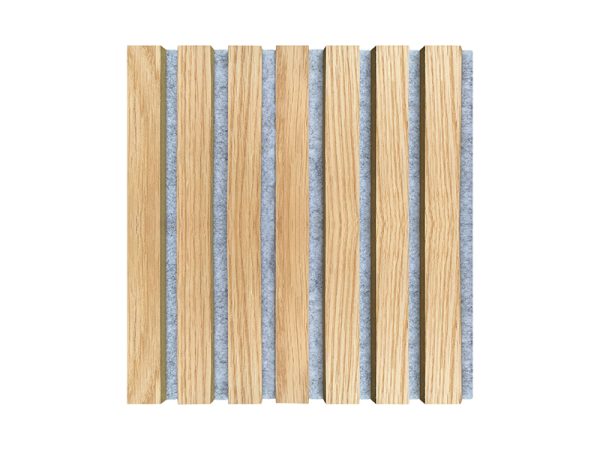
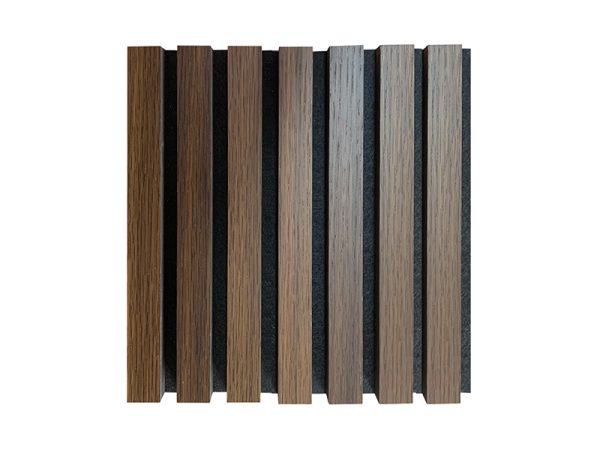
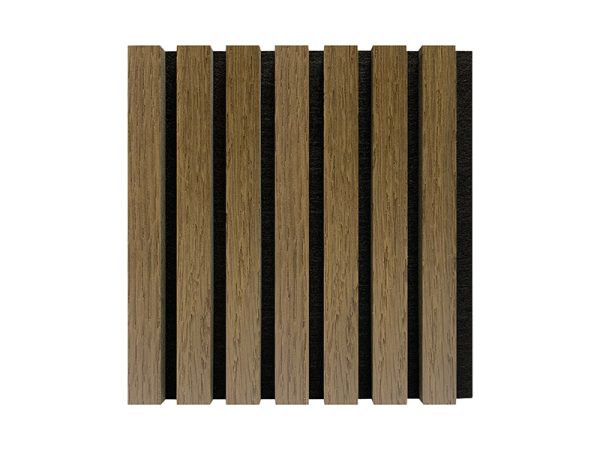
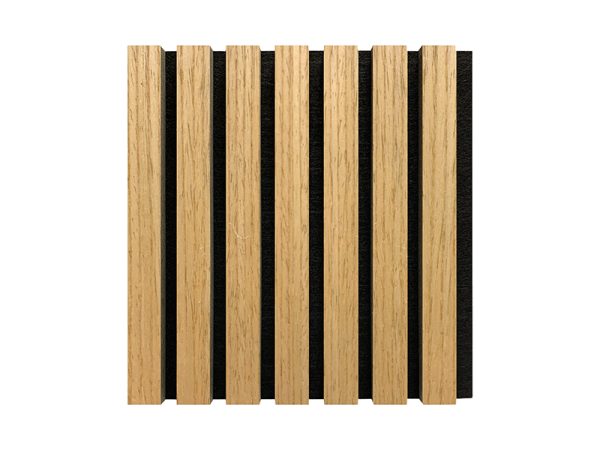
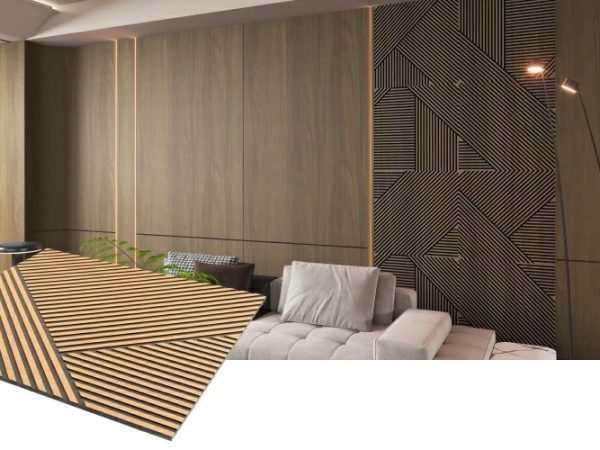
Timber slats bonded over a black acoustic felt backing, supplied as one assembly |
| Fixing |
Screwed through the felt at a slat into the substrate — no frame needed |
| Slat spacing |
The gap between slats is part of the absorber, so two spacings do not perform alike |
| Edge |
A cut exposes the felt core, so every visible edge needs a trim |
| Approach |
Specify by the NRC the room needs, then choose core, thickness and facing to reach it |
| NRC range |
0.70 / 0.85 / 0.95 available, tested to ASTM C423 |
| Standard size |
1220 × 2440 mm, 600 × 600 mm, 600 × 1200 mm; custom sizes accepted |
| Core options |
PET polyester, mineral wool, or slat-over-felt, depending on the figure and the fire class |
| Site cutting |
Cuts with a sharp knife; no saw and no specialist tool needed |
| Fire |
Confirm the class the project requires; a polyester panel is not automatically non-combustible |