Introduction
For furniture makers, cabinet shops, and construction contractors, choosing between MDF, particle board, and OSB is one of the most common decisions. Each has specific strengths — and weaknesses. This article gives you a clear, side-by-side comparison.
What Are These Panels?
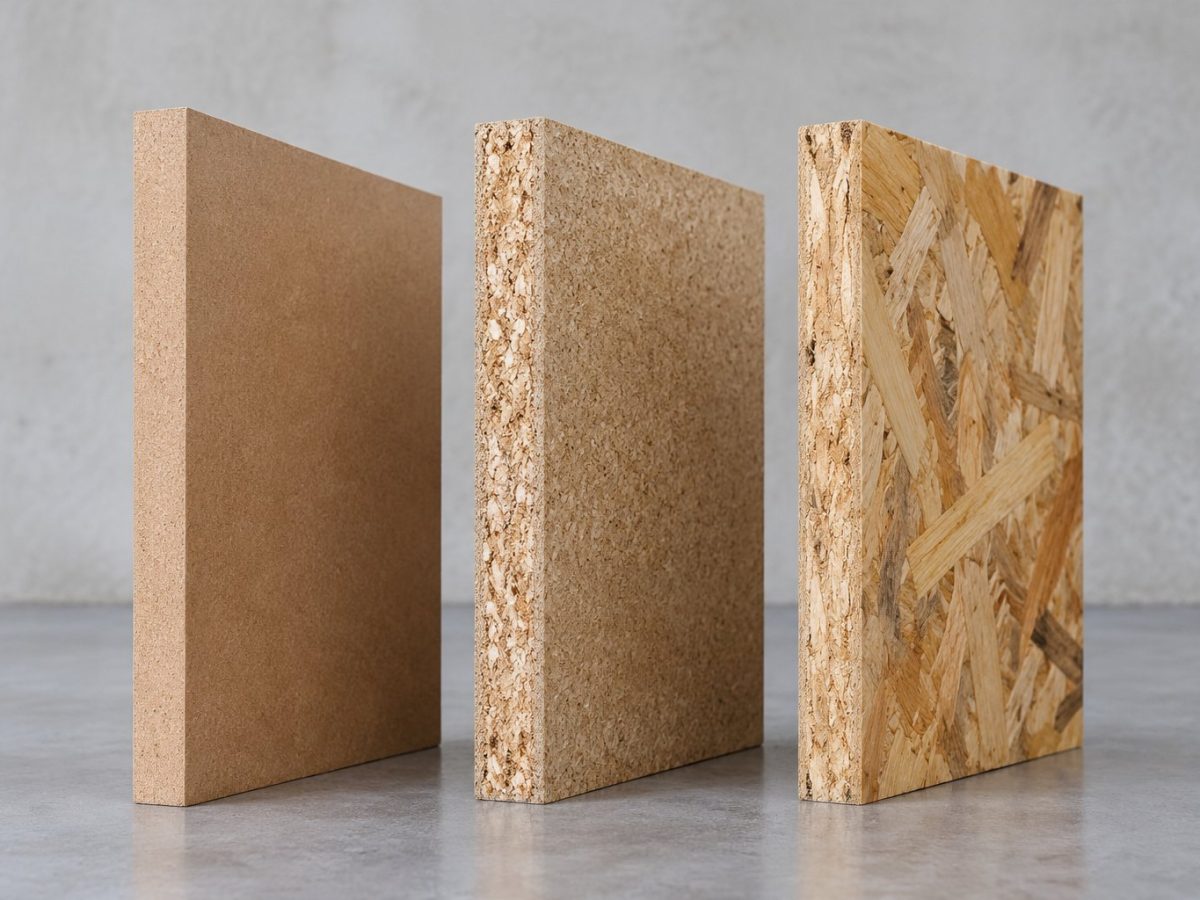
MDF (Medium-Density Fiberboard)
Made by breaking down hardwood/softwood residuals into wood fibers, combining with wax and resin, and forming panels under high temperature and pressure. Density: 600–800 kg/m³.
Particle Board (Chipboard)
Made from wood chips, sawdust, and shavings bonded with synthetic resin. Density: 450–700 kg/m³.
OSB (Oriented Strand Board)
Made from wood strands arranged in cross-oriented layers and bonded with adhesives (usually WBP for exterior grades). Density: 600–700 kg/m³.
Side-by-Side Comparison
| Feature | MDF | Particle Board | OSB |
|---|---|---|---|
| Density | 600–800 kg/m³ | 450–700 kg/m³ | 600–700 kg/m³ |
| Strength | High | Low-Medium | High |
| Moisture resistance | Low (swells) | Very low | Medium-High |
| Screw-holding | Excellent | Poor | Good |
| Surface smoothness | Very smooth | Rough | Rough |
| Painting/lacquering | Excellent | Good (with sealer) | Not suitable |
| Laminating | Excellent | Good (with foil) | Not suitable |
| Weight | Heavy | Light | Medium |
| Cost (FOB China) | $4–$8/m² | $2–$4/m² | $4–$7/m² |
| Formaldehyde emission | E0/E1/E2 | E1/E2 | E0/E1 |
| Best for | Cabinets, furniture, doors | Budget furniture, shelving | Sheathing, packaging, subflooring |
When to Choose MDF
✅ Smooth, paintable surface needed (cabinet doors, decorative panels)
✅ Machining required (routing, profiling, laser cutting)
✅ Furniture requiring screw-holding strength
✅ High-end interior applications
Choose HDF (High-Density Fiberboard) for even harder, denser applications like flooring substrate or door skins.
When to Choose Particle Board
✅ Budget furniture (low-end wardrobes, bookshelves)
✅ Shelving in dry areas
✅ Packaging and one-time-use structures
✅ Lightweight applications
⚠️ Avoid particle board in bathrooms, kitchens, or outdoor use.
When to Choose OSB
✅ Roof, wall, and floor sheathing
✅ Subflooring under carpet or vinyl
✅ Structural packaging (crates, pallets)
✅ Furniture with industrial aesthetic
✅ Light construction in place of plywood
Application Quick Reference
| Application | Best Choice |
|---|---|
| Kitchen cabinets (premium) | MDF with melamine |
| Kitchen cabinets (budget) | Particle board with melamine |
| Wardrobes | MDF or particle board with laminate |
| Doors | HDF / MDF door skin |
| Wall paneling | MDF with veneer or paint |
| Roof sheathing | OSB 11mm–18mm |
| Subfloor | OSB 18mm–22mm |
| Shelving (dry) | MDF 18mm |
| Shelving (heavy load) | MDF 25mm or plywood |
| Packaging | OSB or particle board |
Common Buyer Mistakes
- ❌ Using particle board for kitchen cabinets — swells in 1–2 years
- ❌ Choosing MDF without moisture-resistant grade for bathrooms
- ❌ Using OSB for visible furniture — rough surface doesn't paint or laminate well
- ❌ Ignoring emission grade — E2 is banned in many countries; choose E0 or E1
- ❌ Buying sub-9mm MDF for cabinet backs — too flexible